If you sell across India or set up operations in a new region, tax rules can apply sooner than you expect. You can’t run multi-state operations under one blanket tax ID – the GST framework requires a separate registration for each and every state where you have taxable inventory or supply goods and services. Thats where Virtual Office for GST comes in play.
That means establishing a Principal Place of Business (PPoB) in every territory.
Renting a dedicated commercial space in Bengaluru, Mumbai, and Delhi just to satisfy tax paperwork makes zero financial sense for modern startups and remote-first teams. That is where a virtual office comes in.
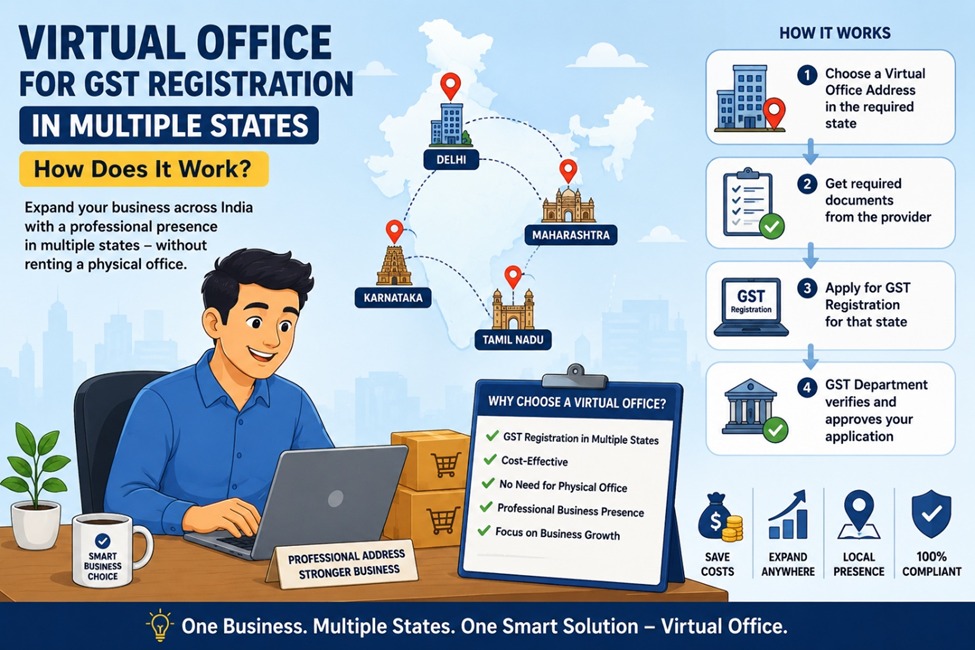
Table of Contents
How Multi-State GST Actually Works
Under Indian GST laws, your tax profile is strictly state-centric.
Take a Delhi-based D2C brand as an example. If you want to store inventory in an Amazon or Flipkart fulfillment center in Maharashtra or onboard local clients in Karnataka, you need a state-specific GSTIN. To get that GSTIN, tax authorities require proof of a physical, commercial address within that border.
Instead of burning capital on 11-month commercial leases, heavy security deposits, and utility bills in cities where you don’t even have on-ground staff, you secure a verified virtual office address in each target state.
The Step-by-Step Setup
Getting a virtual office GST registration ready for tax filing is straightforward, provided you don’t cut corners on the paperwork:
- Pick the Target State & Zone: Identify the hub you need to enter based on your logistics, warehouse network, or customer density.
- Build the Legal Paper Trail: A virtual office setup is valid because of more than just an address on paper. Your provider will have to submit signed Rent Agreement/NOC, recent utility bill (electricity or water) in the name of the owner of the property and usual proof of ownership.
- File the Application: Enter your address as the Principal Place of Business and upload your company documents on the GST portal.
- Pass Scrutiny of Department: GST officers regularly do background cross-checks or issue a Clarification Notice. Having clean, verifiable documentation—and a provider that physically accommodates on-site verifications or signage—makes the difference between quick approval and outright rejection.
Can a Single Address Cover Every State?
The short answer: NO.
A Delhi address cannot back a Maharashtra GST application. You need a dedicated, legally compliant commercial footprint inside each specific jurisdiction:
- Delhi → Virtual office address in Delhi
- Maharashtra → Virtual office address in Maharashtra
- Karnataka → Virtual office address in Karnataka
- Telangana → Virtual office address in Telangana
You aren’t duplicating physical overhead; you are simply building a modular network of compliant addresses across the map.
Who Gains the Most Leverage Here?
It’s built for businesses that move quickly and aren’t tied to physical desks: E-commerce & D2C Brands: To cut down delivery times, you need to keep products in regional warehouses – but that means complying with local GST rules wherever you stock.
Remote-First & SaaS Teams with fully distributed setups and multi-regional compliance needs (no empty leases). Service Agencies & Consultancies: Companies bidding on enterprise or government tenders in states where they need to have a local tax footprint.
What to Verify Before Signing a Provider
Never pick an address provider strictly on price. A rejected GST application wastes weeks, flags your account, and stalls expansion plans.
Before paying:
- Audit the documents: check that the electricity bill is recent and that the rent deed mentions the same property name. Physical Signage Check: Ensure the facility allows you to put up your company name board as per GST norms.
- Check mail management: Important tax correspondence and government mailings will be delivered here; your service provider should have an open desk to scan and forward mail immediately. Prepare for inspections: Ask directly whether their team helps with surprise physical site visits by GST inspectors.
Growth that is smart requires staying lean and fully compliant. Having virtual offices in target states allows you to tap into new sources of income across the country without the operational runway of commercial real estate.
0 109
Leave a Reply